Unloving Love: Inside Penny Goring’s Radically Vulnerable Universe
A journey through love, loss, and the art of surviving both.
REVIEWSBEYOND SAN MIGUEL
Written by Alexandra Rauscher.
4/6/20264 min read
Born in London in 1962, Goring spent decades creating on the fringes before exhibiting her first major institutional solo show at the Institute of Contemporary Arts in London in 2022, aged 60. Now, Unloving Love, a major exhibition of her work - in association with the Fundación Amparo y Manuel, running at the Colegio de San Ildefonso until June 7, 2026 - maps an autobiographical journey of over 30 years and across 113 pieces, including drawings, paintings, poems, collages, videos, and textile sculptures.
Just like our inner battles, Goring’s art is raw and impossible to look away from. "I feel it as an overwhelming shock that both fascinates and unsettles me, and is shaken by current events: politics, injustice and violence", says the artist. Much of her work places the female body at its center - abstracting it, pushing it to extremes. She engages with cruelty, addiction and fear; reflecting on the presence of all of the former in human bonds, often alongside love.
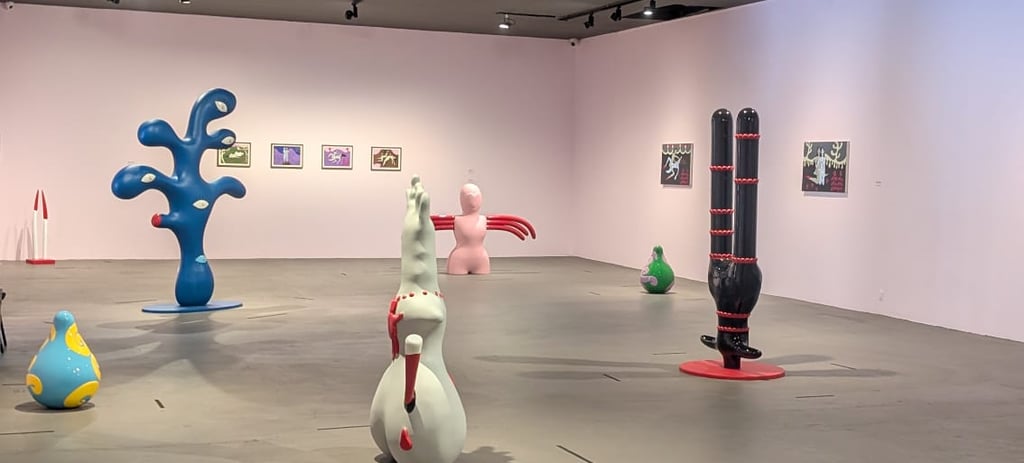
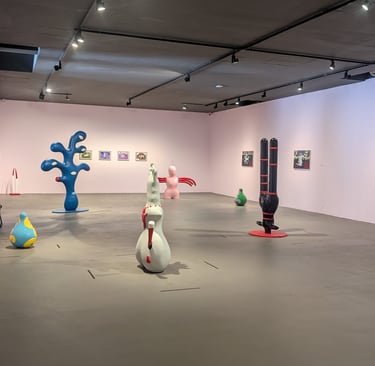
One of the recurring motifs of Unloving Love is the doll - a highly personal textile figure presented in varying forms, colors, and positions. "In my bed, I'm always accompanied by a rag doll that's been with me since I was two years old. Dolls are mysterious and silent; they know how to keep secrets and are very understanding”, says Goring. These figures bring back childhood comfort: something soft to hold onto, a quiet presence in the dark.
About her sculptures, Goring says: "Unlike the doll in my bed, these are not sentimental friends. I use objects as a way of coming to terms with difficult emotions and memories." In a way, they offer comfort, too, yet on a deeper level. In her art Goring uses the superpower all dolls share: the fact that they can be everything we need them to be. For anyone looking in from the outside, a doll might just be a playful object. It’s the owner, who gives it its purpose, decides what it will represent in their world - through the power of imagination alone.
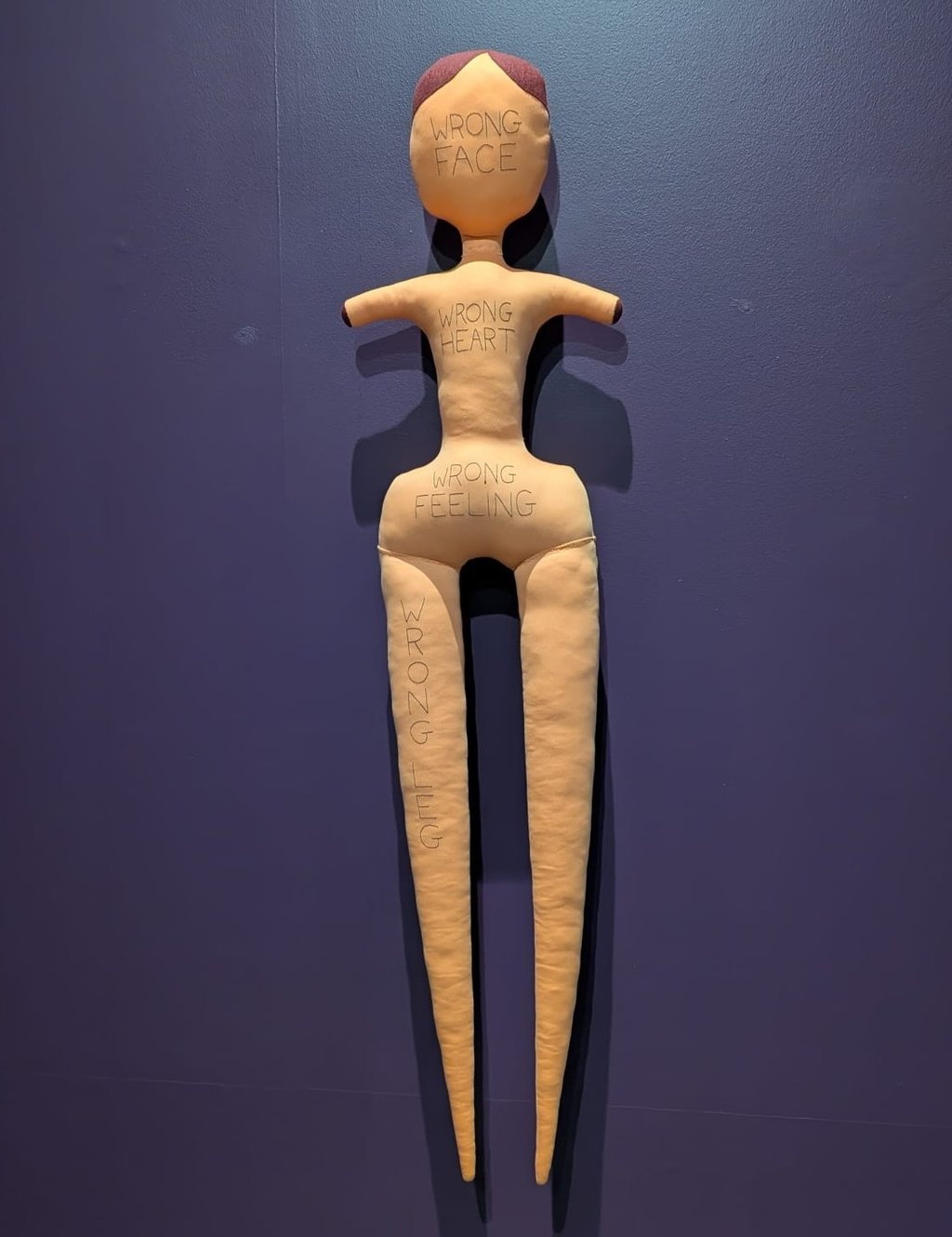
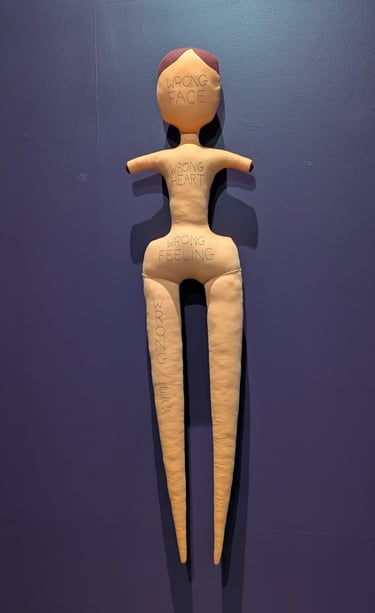
In Goring’s art, comfort and resistance are stitched into the same form. Wrong Doll (2022), for instance, embodies the emotional and physical struggles that haunt the body, her body parts labeled in large letters: "Wrong face" across her head, "Wrong Heart" on her chest, "Wrong feeling" on her stomach, "Wrong Leg" down her limb. Just like her sisters, Wrong Doll is hand-sewn and stuffed by Goring herself.
The exhibition's second main theme is the Amelia series. It captures two women, twin-like in appearance, caught in moments of intimacy. Yet none of the paintings allow the viewer to settle into the ease of a love scene. They are simultaneously cruel - a knife present, blood drawn, one figure turning on the other.
The context comes later: Amelia was Goring's former partner, who died of an overdose. In an act of radical integration, the series presents the two as interchangeable figures - blurring the lines between life and death, love and pain, tenderness and cruelty.
Under the frame of Unloving Love Goring reminds us that all these layers of humanity inevitably coexist. Many types of human relationships bring with them dependency, power dynamics, adaptation. Love in particular, although it might be the most beautiful of human bonds, tempts us to surrender ourselves completely to the other and potentially accept treatment we would not allow if it wasn't for the soft covers of devotion. Love frequently lives alongside violence, control, discrimination, toxicity, loss. The Amelia pieces sit with all of this tension, and at the same time offer, quietly, a glimpse into Goring’s personal grief.
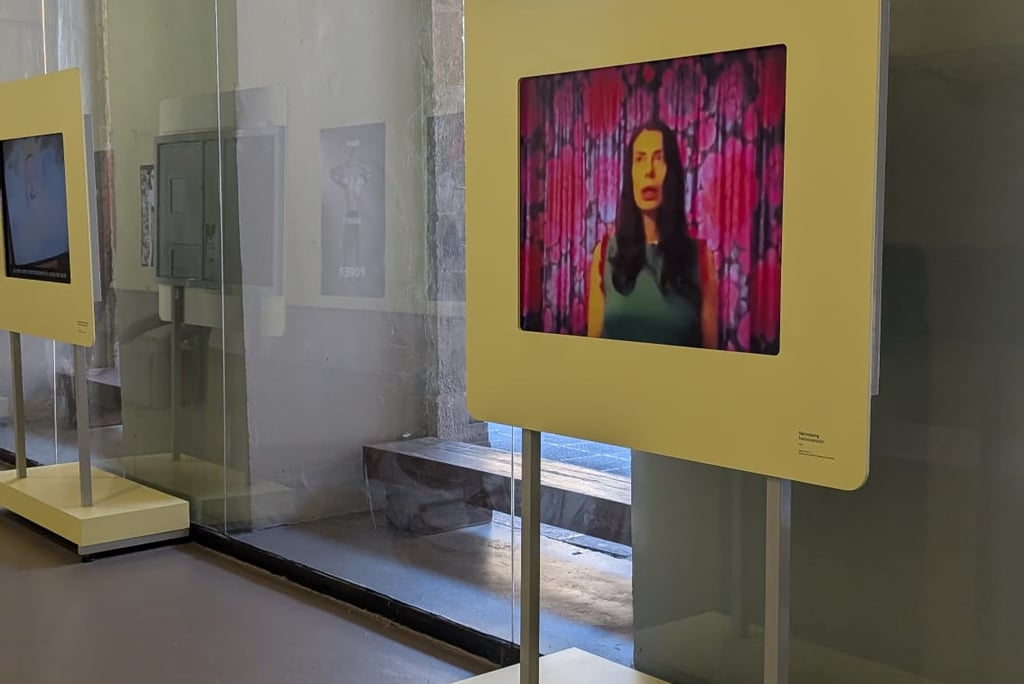
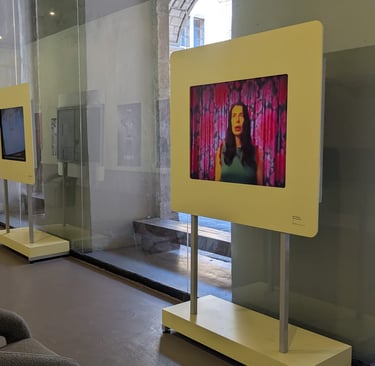
While Goring's work feels intimate, it is never purely insular. Rooted in her life in the UK, she addresses personal trauma and emotional resistance while simultaneously reflecting broader societal realities: austerity, misogyny, poverty, the absence of institutional support. Another recurring figure is her younger self, appearing across her digital collages - works where image and text interact in what Goring calls visual poems. In them, she inserts her own face into various scenes: "The moon, so I own the sky, men, so I own the world, a Rothko painting, so I receive respect."
There is a fascinating tension in Goring’s work colliding with the colonial walls of the Colegio de San Ildefonso - a historic baroque building founded in 1583, whose grand archways and monumental staircases have witnessed centuries of patriarchal power. One thing becomes clear while circulating the gallery rooms: Goring's feminist art is not here to decorate these walls. It confronts them.
Unloving Love, as a whole, is a journey of endurance, an unfiltered path through the messy reality of being human. By letting us into the dark corners of her emotional world, Goring offers a strange kind of comfort. It is certainly not a shortcut to happiness. Instead, it is an invitation to walk through its complexity, trusting that by facing the darkness entirely, we might find the light on the other side.
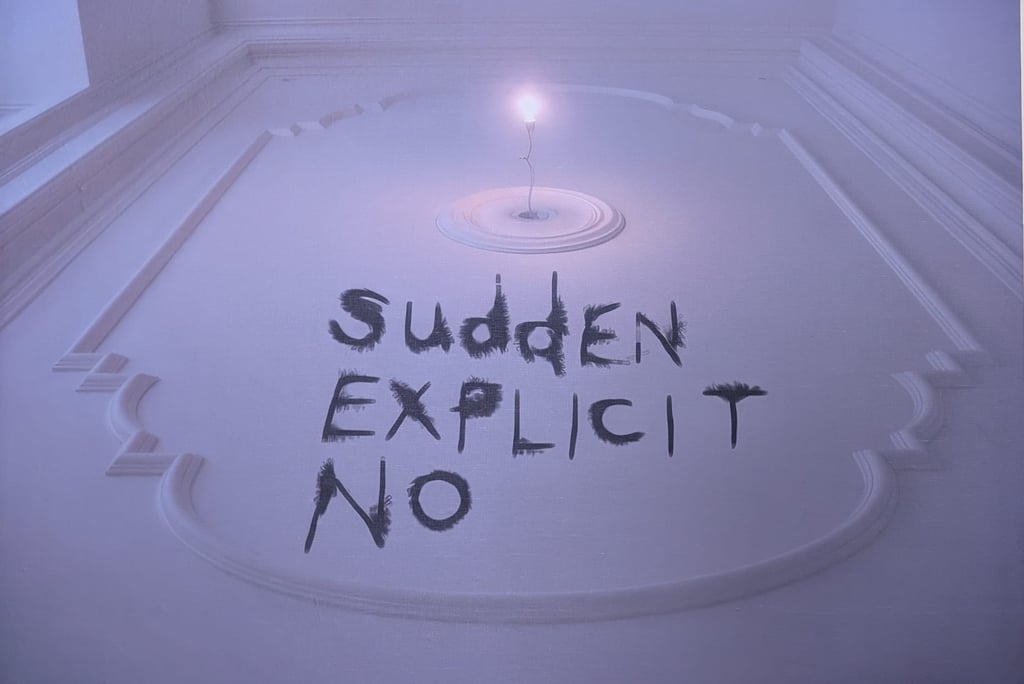
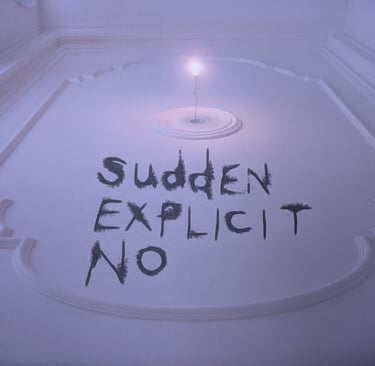
Penny Goring's "No", Printed Vinyl (2026)
Goring's art flows between painting, drawing, poetry, collage, sculpture, and video
Wrong Doll (2022)
The artist herself reappears throughout the installation
Falling in love can be effortless - everything is new, luminous, weightless. The world shrinks to a single person, and everything else fades. Yet when love ends, it takes the lightness with it. Few things are as consuming as the pain of lost love: it arrives in waves, drains color, retreats - and then, just when you think it's over, returns.
There is no escape route from this deeply human state. It is a personal journey that, despite its universality, feels different for everyone. For veteran outsider artist Penny Goring, art has always been her way through: "I take what torments me and transform it. This soothes the pain; it's like turning all the shit into gold”, she explains. The process of making art is her way to confront the fragility of love - and the adversaries of life as a whole.
Contact
Questions or tips? Reach out anytime.
info@artinsanmiguel.com
© 2026. All rights reserved.
Join Art in San Miguel
Stay close to the scene - get fresh stories and event updates.