AztLÁn, Túnel del Tiempo
Between Mythic Homelands and Contemporary Chicano Art. Written by Alexandra Rauscher.
BEYOND SAN MIGUEL
6/1/20265 min read
Long before migration became a highly politicized topic around the world, it was simply human. People left their homes, carrying what they could, in search of something they would often only recognize upon arrival. Moving across borders that did not yet exist, they eventually settled into unfamiliar lands and began to call them home.
This theme of building a cultural identity beyond the simplicity of modern national borders currently takes center stage in the galleries of the Palacio de Bellas Artes in Mexico City with the exhibition “AztLÁn, túnel del tiempo” (“AztLÁn, Tunnel of Time,” on view until August 23, 2026). Curated by artist Rubén Ortiz-Torres and researcher Jesse Lerner, it unifies the work of two collectives and more than 30 artists of Mexican and Latin American descent, most of them based in Los Angeles.
The image of Aztlán, the exhibition’s core inspiration, stretches back to the roots of the Aztec/Mexica people, who are said to have spent two centuries searching for a land promised by their god, guided solely by a shared vision of an eagle on a cactus, awaiting them at their destination. In 1325, they found this new homeland in Tenochtitlan - the foundation for present-day Mexico City. The prophecy of the eagle and the cactus lived on as the central symbol on the Mexican national flag.
Over time, the Aztecs’ original homeland, Aztlán, transformed into a powerful myth. During the 1960s and 1970s, “El Movimiento” - the Chicano movement - adopted this mythic space as a foundational symbol of identity in their struggle to combat racism and assert cultural pride across the USA.
The Chicanos’ story, however, was not one of traditional migration. The reality of what happened is best described in the words of the song “Somos mas Americanos” (“We are more Americans”) by the band Los Tigres del Norte: “Yo no crucé la frontera, la frontera me cruzó” (“I didn’t cross the border, the border crossed me”): When the Treaty of Guadalupe Hidalgo was signed in 1848, Mexico lost about 55 percent of its territory, including California, Nevada, Utah, New Mexico, most of Arizona and Colorado, and parts of Oklahoma, Kansas, and Wyoming to the US. Overnight, the border moved over Mexican families who had lived on that land for generations, making them foreigners in their own homes.
With around 40 million people of Mexican descent living in the US today, the Chicano diaspora remains a defining cultural force, with its beating heart in Los Angeles. “AztLÁn, túnel del tiempo” is the first exhibition focused on Chicano art that is hosted within the main galleries of the Palacio de Bellas Artes, and it arrives at a moment that could not feel more timely. While Washington is actively rewriting the terms of who belongs in America, the participating artists are quietly providing their answer. Refusing to let their complex cultural identity be neglected, the exhibition announces its thesis through a subtle yet powerful typographic choice: the capitalization of the letters "LA" in the title AztLÁn immediately signals how inextricably intertwined Los Angeles and Mexican culture truly are.
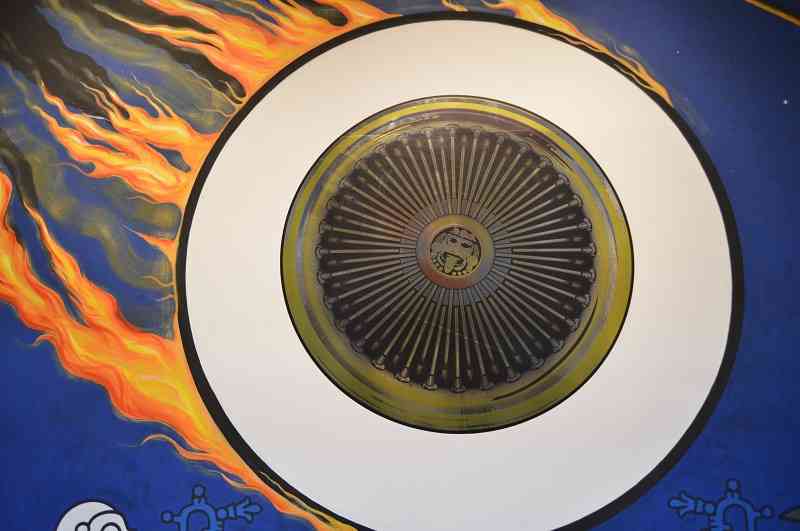
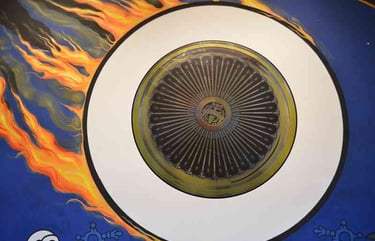
Before entering the galleries, visitors are met by El más allá (2026), a large mural showing a lowrider wheel with the Aztec Sun Stone at its core, flames trailing behind it - an image from the streets of LA carrying an indigenous symbol on its inside. The first commissioned mural in the building since the 1960s, the work by the Los Angeles-based 3B Collective now shares walls with neighbouring pieces of Diego Rivera, José Clemente Orozco, and David Alfaro Siqueiros.
The time tunnel promised by the exhibition title takes visitors through four sections: East Side Stories, Varrio, Desmuralismos, and Transtemporalidades. Each approaches Chicano identity from a different angle. From the streets and subcultures of East LA to the intersection of indigenous symbolism and contemporary pop culture, the works insist: Chicano culture is alive.
At the center of the exhibition is the piece Mexica Falcon after Dewey Tafoya (2024) by Rafa Esparza. The large adobe sculpture, hand-formed from raw earth and clay - one of the oldest building materials in the Americas - fuses the forms of the Aztec Sun Stone with the Millennium Falcon from Star Wars. Ancestral knowledge and mass culture come together in the same object, demonstrating that in Chicano art, these influences are inseparable.
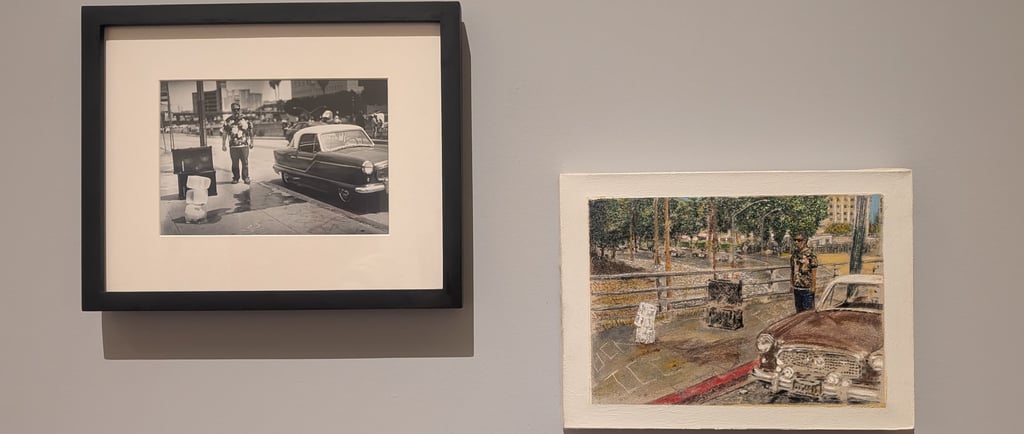
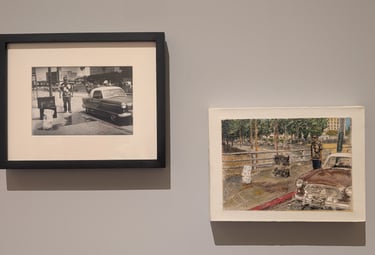
The present political momentum enters the gallery most explicitly through the work of Raul Baltazar. During last year’s "No Kings Day" protests in Los Angeles - demonstrations against mass deportations and the expansion of authoritarian power - Baltazar performed “Ice Melts”, placing three large blocks of ice to dissolve under the Southern California sun. As they melted, the soundtrack of the 1969 Czech film The Cremator played in the background as a reference to the machinery of totalitarianism.
Baltazar’s message was simple: no matter how imposing the structure, “it's going to melt away.” The performance, captured in a photograph by Octavio Loera, was later painted in acrylic by the artist. Displayed side by side with the photograph, and alongside insights from community reactions to the performance, the artist’s works carry the heat and political friction of US streets into the Palacio de Bellas Artes in Mexico City - the city built on Tenochtitlan, where the Aztecs found their new home about 700 years ago.
The question of where the original Aztlán actually lay - whether in northwestern Mexico, the southwestern US, or nowhere physical at all - has never been resolved. Yet standing in the gallery rooms of “AztLÁn, túnel del tiempo”, this question feels beside the point. Aztlán was never a place on a map. It was something people carried with them when they left, and something they rebuilt wherever they arrived. For those who stayed while the world around them moved, Aztlán is part of the grounds they still live on today.
The artists united in this exhibition did not wait for borders to be settled or for political climates to improve. They simply continued to express themselves through art: across generations, across the US-Mexico divide, to now lend their work to the halls of a building that has long defined what Mexican culture is - a conversation that has always been larger than any one country could contain.
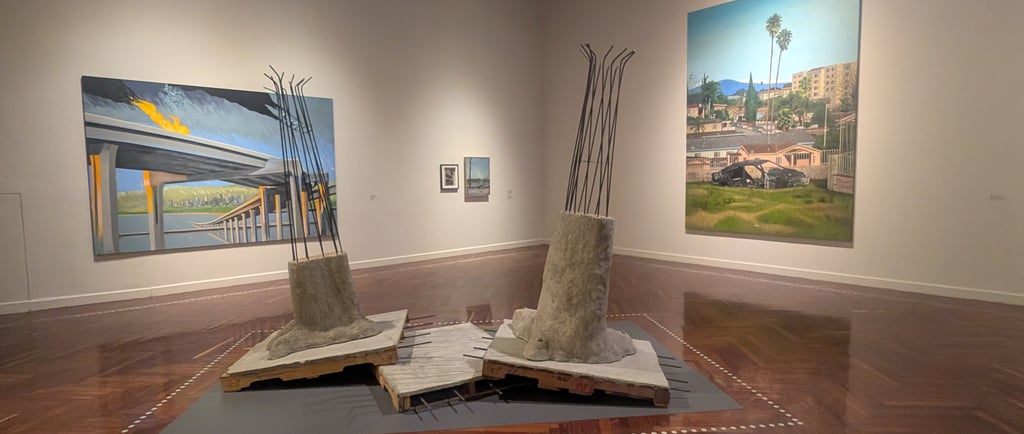
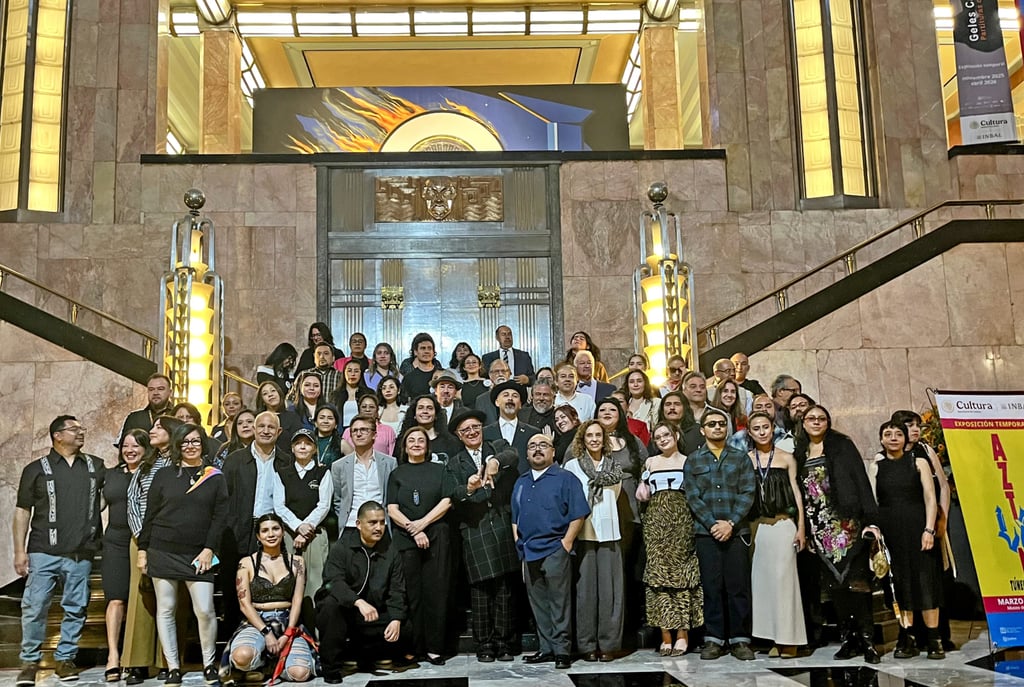
"AztLÁn, tunel del tiempo" unites over 30 Chicano artists. Photo: Arturo Lopez / INBAL
The mural "El más allá" by the 3B Collective
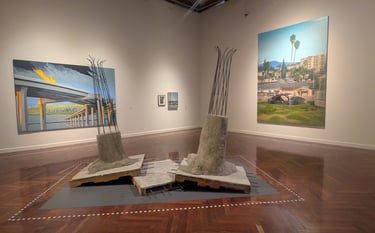
A glimpse into the exhibition
Baltazar's performance "Ice Melts", captured in photo and acryl
Contact
Questions or tips? Reach out anytime.
info@artinsanmiguel.com
© 2026. All rights reserved.
Join Art in San Miguel
Stay close to the scene - get fresh stories and event updates.