
Give Me Some Light
The Life & Work of Peter Leventhal. Written by Jon Bonfiglio.
MONOCLE
5/24/20263 min read
Leventhal moved to San Miguel in 2002, although he had already been visiting the city for twenty years by that point. He came for many reasons, but a central rationale was the human quality of life which he felt no longer existed in the United States. “The way people hold their children, the way that they correspond with one another… I have a great affection for those qualities,” he said. Leventhal had grown up in the New York City of the forties and fifties, where he had free access to the Metropolitan Museum and the New York Public Library, among hosts of others, but it is these two which he regularly referenced through his life as being foundational places of learning for him. Thereafter, he moved widely, as many artists do, seeing, smelling, learning — understanding what the world consisted of, and how he might come to leverage a small space for himself within it.
Leventhal had always drawn, as far back as he could remember. Painting, however, was something else entirely for him, a practice he would come to describe as “a wrestling match.” He also happened to grow up in a post-war age which — in struggling to make sense of preceding wars and a drive towards industrialization (and seemingly annihilation) — was fixed on abstraction. It was the language of choice. Everything outside of abstraction was seen as being dated — a cultural aberration which could in no way speak meaningfully to the context of the mid century. Leventhal didn’t much care, however. He knew who he wanted to be, and he was as certain of that as he was of the fact that his art was figurative, and that it must tell stories. He was, in short, single-minded, unwavering.
Artists have gravitated to San Miguel de Allende since just about forever. The more understood waves of interest include the presence of the Mexican greats, with individuals such as David Alfaro Siqueiros — who taught and worked in the city, famously organizing student strikes at the art schools — and Diego Rivera. Alongside these also sit an international series of arrivals which came on the heels of the presence of Stirling Dickinson, the American artist who helped found the Instituto Allende and was instrumental in transforming the city into the global arts destination we see today.
Across these decades, the city has also seen the arrival and participation of the likes of the unique figure of Pedro Friedeberg, Leonard and Reva Brooks, and Felipe Cossío del Pomar, the Peruvian artist and diplomat who founded the original art school that eventually became the Instituto Allende.
Another singular figure who deserves attention is Peter Leventhal.
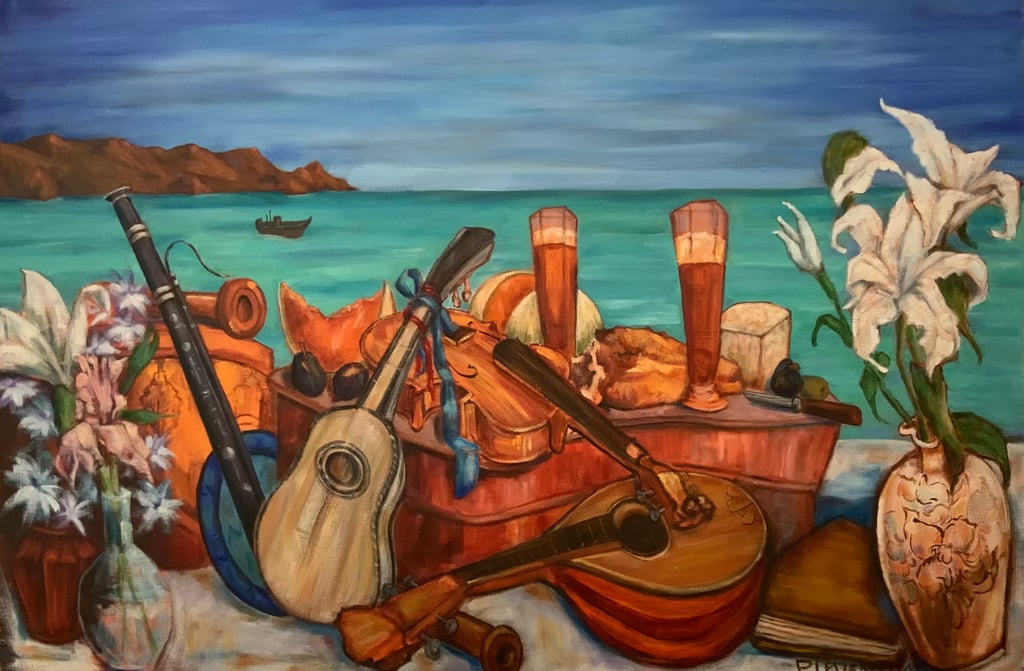
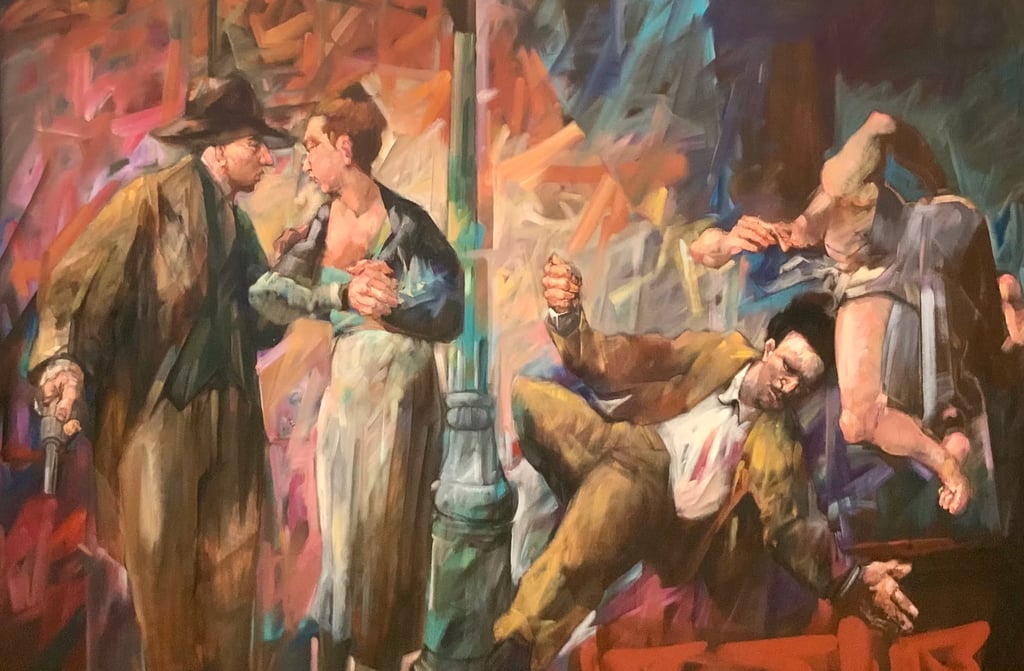
Leventhal’s artworks, seen today, are highly distinctive. Not in the way that they have evolved into a unique, hyper-stylized signature, but in that his figures emerge through a variety of prisms, depending on the subject matter. Perhaps most well-known are Leventhal’s Dionysian figures, all slightly bloated from their presence in the bacchanal, but there are plenty of other filters through his work, including heavier tones which feature still-life items and certain joint portraits (such as ‘Lily’ and Mechanic of our Dreams’)’, and then a strand of especially tonally complex paintings, the likes of which you feel can never be fully deciphered, no matter how long a viewer might spend in the attempt. Among these, an unquestionable masterpiece is ‘The Assassination’, a street scene depicting the night of January 10, 1929, when Julio Mella, young head of the Cuban Communist Party in exile in Mexico City, was shot while he was walking with his lover, Tina Modotti. Modotti would later be implicated as an accomplice in the murder, and spent the rest of her life looking over shoulder for expected reprisals. The painting, in that sense, is not just a moment in public history, but also one of personal rupture for all involved.
Although the exact number of paintings Peter Leventhal produced over his lifetime is not officially documented, there is little doubt that he was a highly focused, prolific artist. Alongside his paintings, he also worked in printmaking and wood sculpture, and barely paused for breath through his several decades of work across New York, France, Florida and — finally — the place he settled, San Miguel de Allende.
"Music at the Beach" by Peter Leventhal
"The Assassination" by Peter Leventhal
Contact
Questions or tips? Reach out anytime.
info@artinsanmiguel.com
© 2026. All rights reserved.
Join Art in San Miguel
Stay close to the scene - get fresh stories and event updates.