
The Man in the Striped Pantalones
Peter Leventhal, Creator and Character within his own Bacchanal. Written by Auri Fernandez Osornio.
MONOCLE
7/1/20264 min read
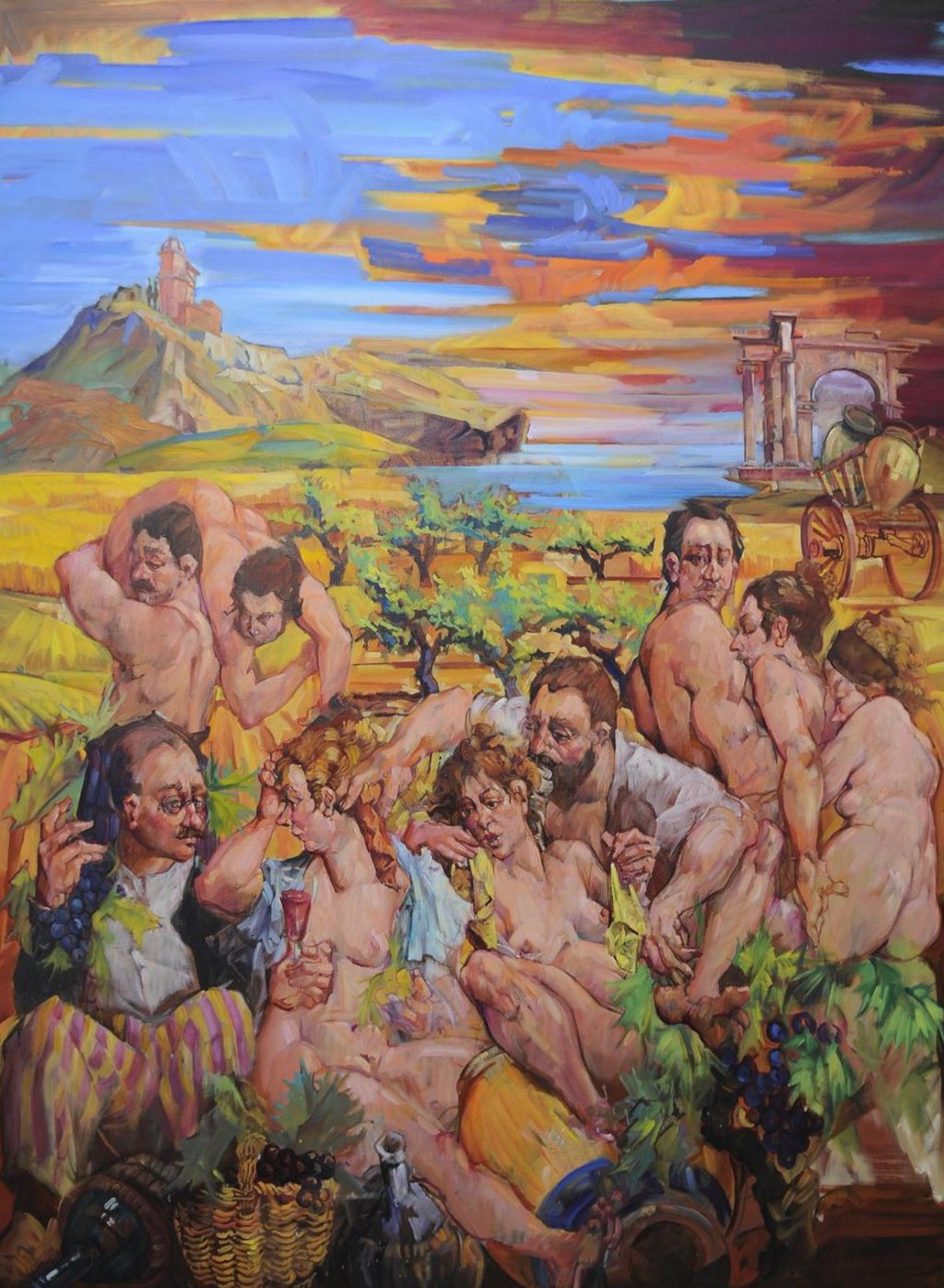
A piece of Bacchanalian wine art by San Miguel de Allende-based artist Peter Leventhal captures a situation most of us have found ourselves in at one point: a moment where we are surrounded by people yet somehow remain on the outside looking in. Anyone who delves deeper into Leventhal's life will notice that he was often neither quite an outsider nor quite an insider. This, however, made him an all the keener observer, watching the world with a slight but knowing distance, and translating this particular view into his art.
Leventhal would often take on commissions from personal clients, taking their recommendations into account and adding his own distinctions. "I showed him three of my favorite Rubens as examples of the look I wanted. One of them was Rubens' 'The Feast of Venus'," recalls San Miguel de Allende real estate broker Greg Gunter, who in 2007 engaged Leventhal to create a Bacchanalian wine scene for a new home he was building.
Gunter recounts the artist getting misty-eyed over seeing that specific piece of art, recalling that he found that work of art in his father's library art book at the age of eleven and said, "Someday, that's what I will paint!" Without a doubt in his mind, Leventhal got to work, painting four different models for Gunter in the span of twelve months, each of which Gunter approved, saying, "I think my commission was one of his favorites."
The piece depicts a unique scene, evocative of a picnic, in which a handful of scantily clad men and women bask in the sun. The characters wear serious expressions, yet they demonstrate comfort with one another - a sense of comfort that perhaps arises from the youthfulness implicit through their skimpy dress. Neither the men nor the women seem afraid to be vulnerable. In the foreground, two men and two women take in the air, eating fruit and drinking wine. Meanwhile, in the background, a man carries a woman, and a man and two women are entangled with one another, evoking a sense of play for the viewer. The backdrop consists of the arches and churches Querétaro is known for, blending influences and colors from the US and Mexico.
Drawing the eye away from the revelers is a man who sits apart from the rest: clothed and positioned to the front left, present nonetheless. At Gunter's request for one reveler to wear striped pantalones among the naked Bacchanalian crowd, Leventhal chose to paint a younger version of himself. "That's part of why I treasured that specific work so much," Gunter says. This meta-artistry mirrors how the artist and viewer alike exist just outside - yet are drawn in, if they allow themselves to be.
The contrast between a younger, dressed Leventhal and the naked community around him also speaks to an open invitation extended to those who may not feel inclined to expose themselves. There seems to be a lack of pressure to present oneself a certain way, and an emphasis instead on presence and community. One is left with the impression that each individual wants to be there - comfortable in their own bodies, enjoying one another's essence. Yet one of the most beloved attributes of Leventhal's abstractionism is the space it gives viewers to interpret the characters on their own.
Considering the piece in its entirety, one might ask: Why does this painting feel so avant-garde? Perhaps it's because of Leventhal's ability to draw from many fountains of inspiration when interpreting the world around him. Originally from New York City, it was the architectural beauty of San Miguel de Allende that drew him in, as it had happened to so many foreign and national artists alike. Leventhal did not simply mimic this environment but emulsified himself into it, producing a unique art style reminiscent of the Harlem Renaissance's abstract visuals, thereby adding his own broad stroke to the local art scene.
Gunter befriended Leventhal, conducting a formal interview with him around 2011. When Gunter asked why the female models in his paintings were always half-dressed and sensually Rubenesque, Leventhal recalled his Saturdays as a youth in the 1930s, when lower Manhattan still had open fields where the Chicanos would meet. The men congregated and worked on their cars, while the ladies took picnics together - no men around - and took in the sun with scanty sundresses. Rooted in the spirit of the 1920s feminist movement, these scenes reflected the growing freedom with which women were expressing themselves more freely. This awakening became a direct source of inspiration for Leventhal. As he put it: "They were always nonchalantly falling out of their dresses, and I loved portraying that innocent sensuality these women were so comfortable with."
Gunter, also a novelist, noted how Leventhal's subjects were always 'characters' with unique characteristics that arrested your eye and made the viewer wonder, "What's their story?" "I can stare at his characters for hours sometimes," he says, "and make up my own story about each one of them." One could infer that Leventhal's love for Mexican culture's human quality of life rooted in third places was the same type of love he had for Bacchanalian revelry, Chicano culture, and the elegance of nakedness represented in abstract form.
Leventhal was well known throughout San Miguel for still working as his Parkinson's worsened and continuing to paint - eventually needing to hold the brush with both hands - until the day he passed away in 2019. His works can still be found around San Miguel, most recently at a May 2026 exhibition at Lavinia's Framing Gallery, where some of his older pieces were shown. Leventhal's widow, Terra Mizwa - a highly accomplished artist in her own right - will occasionally showcase remaining works of his art and probably could locate other pieces for Leventhal collectors like Gunter. "I just need a bigger house," Gunter jokes, "so I can add more of Peter's works to my collection."
In effect, Leventhal's abstract approach to art was not only a style but a lifestyle. Indicative in his art is the fluidity with which Leventhal lived his life - as an outsider within. Drawing inspiration across eras and borders, without a doubt, Leventhal could be considered a multicultural savant. His impact not only endures on the walls of colonial homes and museums but also in the memory of those who understand his work and what he wanted to accomplish: "to emulate the ample, complex construction of the art of the past - figurative, narrative, and elegant."
Peter Leventhal's Bacchanalian wine art
Contact
Questions or tips? Reach out anytime.
info@artinsanmiguel.com
© 2026. All rights reserved.
Join Art in San Miguel
Stay close to the scene - get fresh stories and event updates.